Judging a Repair by Watts Instead of Hashrate
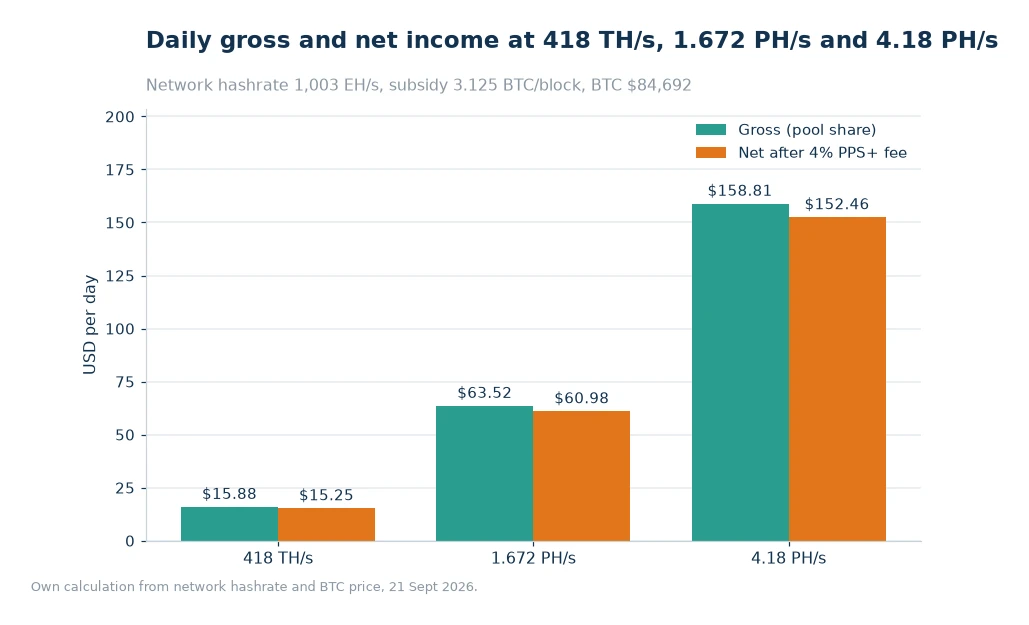
A 418 TH/s miner earns $15.88 a day gross at the 21 Sept 2026 values, which is $15.25 net after the listed block-reward charge. Its power draw decides whether that is a healthy machine or a marginal one: at 20 J/TH the electricity costs about $12.04 a day at $0.06 per kWh, leaving $3.21. A repair bench that only measures hashrate is measuring the wrong half of the problem.
Key takeaways
- At 418 TH/s the day is $15.88 gross and $15.25 net before any power cost is counted.
- At 20 J/TH the machine burns 8.36 kW, or 200.64 kWh a day, costing $12.04 at $0.06 per kWh.
- At 25 J/TH the same hashrate costs $15.05 in power, which leaves $0.20 of margin a day.
- A repaired board that restores hashrate but worsens efficiency can be a net loss.
A repair is a bet on the next twelve months
When a board comes off the shelf with a dead channel, the immediate question is whether it can be fixed. The better question is whether the fixed version should run. Those are different tests, and a bench that answers only the first will return machines to service that quietly erode the site's margin.
Twelve months is a reasonable horizon for the bet. A machine that runs at a healthy efficiency for a year produces a predictable stream of coin; one that runs at the edge of viability produces a stream that a single difficulty print or a rate rise can erase. The repair cost is only part of the stake.
Efficiency is the number the label hides
Manufacturers quote joules per terahash at a favourable point, often at a particular ambient temperature and with a fresh power supply. In a working shed the same machine can be several points worse, and those points are multiplied by 418 TH/s all day. A one joule per terahash change is 418 watts, which is roughly 10 kWh a day and $0.60 at the rate used here.
This is why the ViaBTC Mining Calculator is only half the picture. It gives the income side at a chosen hashrate, and the power side has to come from a meter on the bench. Bring both to the decision, or the calculation describes a machine that does not exist in your building.
The Profit Calculator is the quicker form when a customer asks what a machine would earn before leaving it for service. Run it once at the rated hashrate, once at the derated figure, and quote both. The pair of answers sets an expectation the bench can then confirm or correct.
Three efficiency assumptions on one machine
The table keeps hashrate fixed at 418 TH/s and varies only the efficiency, which isolates the effect a repair or a power-supply swap can have. The margin column is net income minus the power bill, before rent and labour.
| Efficiency | Draw | Energy per day | Power cost | Margin |
|---|---|---|---|---|
| 15 J/TH | 6.27 kW | 150.48 kWh | $9.03 | $6.22 |
| 20 J/TH | 8.36 kW | 200.64 kWh | $12.04 | $3.21 |
| 25 J/TH | 10.45 kW | 250.80 kWh | $15.05 | $0.20 |
Look at the bottom row and then at the cost of a repair. A machine at 25 J/TH has almost no room for a parts bill, a travel charge or an hour of labour. The same repair that makes sense on the top row can be wasted money on the bottom one, even though both machines hash at the same speed.
What the test bench can tell you
Three measurements turn a repair from a guess into a decision. First, wall power at the operating point, taken with a clamp or a metered socket rather than inferred from firmware. Second, delivered hashrate over a sustained run, not the first two minutes. Third, the temperature of the board and the supply after twenty minutes, because a unit that only holds its numbers when cold will not hold them in summer.
Record the ambient temperature with the result. A board that draws 8.36 kW at 20 J/TH in a cool workshop may draw more in a warm room, and the difference is the cooling system doing extra work rather than the miner becoming less efficient. Without the ambient figure the measurement is not reproducible.
Worked example
Turning the middle row into a decision, step by step:
- Daily issuance: 144 × 3.125 = 450 BTC.
- Per terahash: 450 ÷ 1,003,000,000 = 0.00000044865 BTC each day.
- Machine output: 418 × 0.00000044865 = 0.00018754 BTC, recorded as 0.00018752.
- Gross: 0.00018752 × 84,692 = $15.88. Net at the listed 4%: 15.88 × 0.96 = $15.25.
- Power at 20 J/TH: 418 × 20 = 8,360 W, or 8.36 kW.
- Energy: 8.36 × 24 = 200.64 kWh; at $0.06, 200.64 × 0.06 = $12.04.
- Margin: 15.25 − 12.04 = $3.21 a day, or $96.30 across 30 days, before rent and labour.
- At 25 J/TH the draw is 10.45 kW and the power bill $15.05, leaving $0.20 a day, so a repair costing $150 would need more than two years of margin to repay.
Repair, derate or retire
There are three outcomes, not two. A board that comes back to full efficiency goes back into service. A board that works but draws more than its peers can be derated, running at a lower clock to protect the margin, which is often better than scrapping it. A board whose best achievable efficiency leaves no margin should be retired, and its slot given to hardware that can use the circuit.
Derating is underused because it feels like a failure. In practice a machine running slightly below its label, at a much better efficiency, can out-earn one chasing the last few terahash. The site's total margin is the objective, not the number printed on the box. Write the derated setting on the card so the next technician does not undo it.
Recording the bench result
Every repaired unit should leave with a card: wall watts, sustained hashrate, efficiency, ambient temperature, date and the parts used. That card is the only way to compare one repair with the next, and it is the first thing a buyer asks for when a machine is sold on. A bench without records is a bench that repeats its mistakes.
The card also feeds the site's decision about which models to keep. After twenty repairs, the cards will show which designs hold their efficiency and which drift, and that pattern is worth more than any single repair's outcome.
Frequently asked questions
Why measure at the wall rather than in firmware?
Firmware reports board power and misses supply losses, fan draw and measurement error, so a wall reading is the only figure that matches the electricity bill.
What efficiency makes a machine worth repairing?
There is no universal threshold; compare the margin after power with the repair cost, because at 25 J/TH a 418 TH/s unit leaves only about $0.20 a day.
Does a higher hashrate always mean more profit?
No. At a fixed efficiency a higher hashrate scales both income and power, and the margin only improves if the efficiency improves with it.
Measure before you decide
Put the meter on the machine before the parts order goes out. Ten minutes of measurement turns a repair into a decision with a number attached, and it protects the site from the most expensive kind of fix: one that restores a machine nobody should be running. The Miner Profitability Ranking is a useful reference for how a model compares before it reaches the bench.
Keep the card, keep the meter, and let the second repair be cheaper than the first because the records already exist. That is the whole method, and it needs no software beyond a notebook and a clamp. For the income side of the card, the fee schedule is the piece most often left out, and it is the one that decides what the margin column means.
Sources: the ViaBTC calculator and miner ranking pages for income and model inputs; power priced at the $0.06 per kWh example in the published fact set[1]. Chain data of 21 Sept 2026: 1,003 EH/s network hashrate, 3.125 BTC subsidy, 144 blocks a day, BTC $84,692. Published 24 Oct 2026; margins exclude rent, labour and cooling overhead.