Choosing Tank Sizes for a First Craft Brewery
A first brewery rarely needs the largest vessel it can afford; it needs the batch size it can sell twice a week. Hermann publishes a size ladder that begins at a 200 litre nano kit and climbs through 300, 500, 1,000, 2,000, 2,500, 3,000 and 5,000 litres to a 10,000 litre (10 T) system, so nearly every first-year plan lands somewhere in the middle of that range. The hem brew system you order should fit your second year of trading rather than your opening weekend.
Key takeaways
- A 1,000 litre batch brewed twice a week leaves about 1,960 litres of packaged beer a week after a 2% transfer loss, which is roughly 17 barrels (1 BBL ≈ 117 L).
- Published sizes run from a 200 litre nano brewery to a 10,000 litre (10 T) system, with a 500 litre three-vessel kit and a 2,500 litre four-vessel kit in between.
- Tank count, not kettle size, fixes how many beers you can have on at once, because a fermenter is occupied for two to four weeks per batch.
- Every tank ships with a data plate carrying its pressure-testing record and serial number, so the fill level a vessel was tested at always has a documented answer.
Start from weekly sales, not from a catalogue
Write down the volume your best market absorbs in a week and divide it by the number of brewing days you are willing to work. A taproom turning over 600 litres a week needs about 300 litres from two brewing days, which is the bottom of the ladder rather than the middle. Wholesale moves the figure fast: one 30 litre keg per week across ten bars is 300 litres before the taproom is counted at all. Those two numbers, taproom and wholesale, are the real ends of your sizing problem, and the batch you choose has to satisfy both without leaving beer sitting in a tank for a month.
What the published size ladder actually offers
The product listings give buyers a genuine ladder instead of three fixed models: a 200 litre nano brewery, 300 litre and 500 litre microbreweries, a 500 litre three-vessel unit, 1,000 litre brewing houses in two, three or four-vessel form, a 2,000 litre build in two-vessel copper or three-vessel stainless, a 2,500 litre four-vessel set, and then 3,000, 5,000 and 10,000 litre systems. Each step changes a different constraint. Below 500 litres the limit is usually floor space; above 2,000 litres it is steam, water and drainage; above 5,000 litres it is cold storage and packaging. Starting from what the factory has already built many times is safer than starting from a wish list.
| Published size | Example batch volume | Example monthly packaged litres |
|---|---|---|
| 300 L microbrewery | 300 L | about 2,350 L |
| 500 L microbrewery or 500 L three-vessel | 500 L | about 3,920 L |
| 1,000 L brewing house (two, three or four-vessel) | 1,000 L | about 7,840 L |
| 2,000 L brewing house | 2,000 L | about 15,680 L |
| 5,000 L brewing house | 5,000 L | about 39,200 L |
Working volume is not tank volume
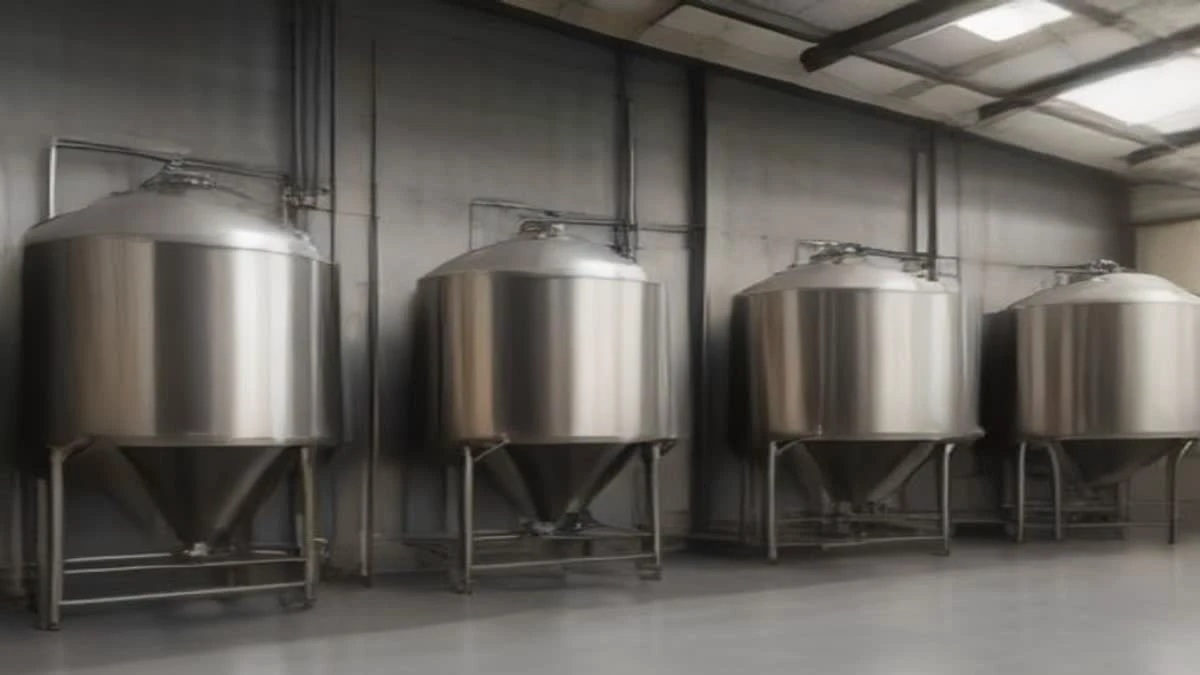
A fermenter is quoted by working volume, which sits below the brim, and the space above it is where foam grows during the first days of a fermentation. That is why a 1,000 litre tank on a drawing and a 1,000 litre batch are not the same statement. When proposals come back, ask each supplier whether the number on the vessel is gross or working volume, and ask what pressure the vessel was tested at. The published data plate on every tank carries the pressure-testing record and the serial number, so the answer is a document you can keep, not a verbal assurance. Multiplied across four or five vessels, a fill level that is ten per cent optimistic changes how many beers you can brew at once.
Two more numbers belong beside the batch size: how much packaged beer you can store cold, and how long one of your beers takes from brew day to first sale. A batch size that suits a busy Friday can be a liability in a quiet February, which is why a smaller tank used more often is generally a safer first purchase than a large one used occasionally. Sizing the cold room and the keg store at the same time as the hot side keeps those two pressures in balance and stops a brewery buying capacity it cannot chill.
Matching tank count to the beers you list
Fermentation is the slow stage: a vessel stays occupied for two to four weeks depending on style, while the hot side of the brewery may finish its work in a single day. Bottling, canning and kegging add another queue behind it. A brewery listing four beers therefore needs at least four vessels of its batch size, plus bright beer capacity and glycol cooling to hold them at temperature. Buyers who size the hot side first and add fermentation vessels in a second order usually spend less on cooling, pipework and pumps than buyers who start with a large kit that runs half full for a year. Because the fermentation vessels are listed as their own part of the range, a staged order is a normal way to grow.
Worked example: two routes to the same weekly output
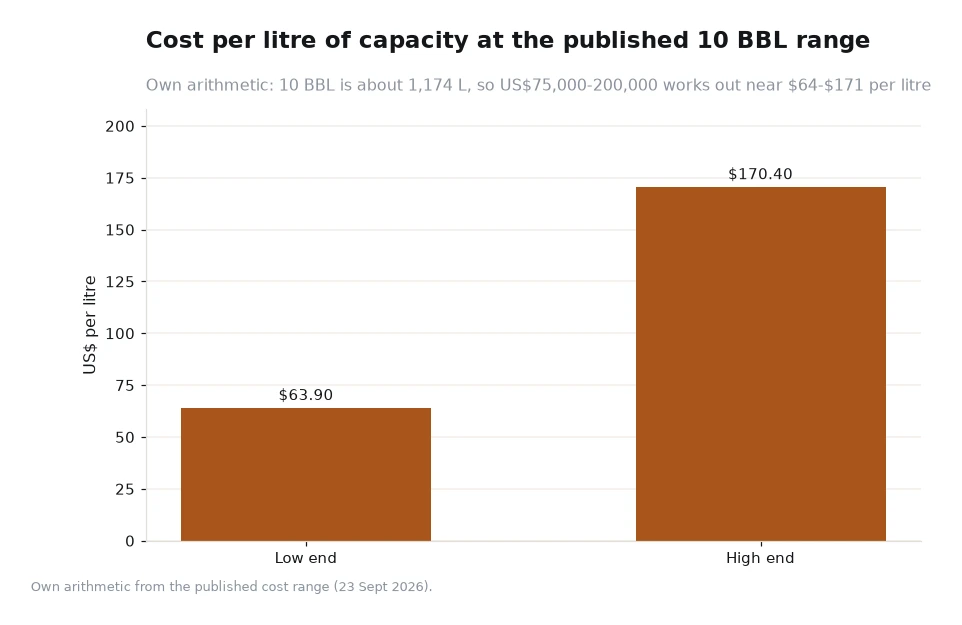
Every assumption is stated, and the output is an example. Target: 1,900 litres a week, five brewing days, 2% transfer loss on each batch. Route A uses one 1,000 litre batch twice a week: 1,000 x 0.98 = 980 litres per batch, and 980 x 2 = 1,960 litres a week, or about 17 barrels at 117 litres to the barrel. Route B uses a 500 litre batch four times a week: 500 x 0.98 = 490 litres, and 490 x 4 = 1,960 litres a week — the same beer out of the door. Route B needs twice as many brewing days and roughly twice the hot-side labour hours, but a smaller kettle, a smaller hot liquor tank and less steam. Route A needs a two or three-vessel line of 1,000 litres and only two fermentation tanks to hold the same weekly volume. For scale, the published cost example of a complete 10 BBL system is US$75,000-200,000; divided by 1,174 litres (10 BBL) that is about US$64 to US$171 per litre of capacity, a reference figure rather than a quote for your own build.
Frequently asked questions
What batch size should a first craft brewery start with?
Most first breweries sit between 500 and 1,000 litres per batch. A 1,000 litre batch brewed twice a week packages about 1,960 litres a week after a 2% loss, which is roughly 17 barrels.
How many fermentation tanks does a 1,000 litre brewery need?
At least four if you want four beers on at once, because each vessel is occupied for two to four weeks; two tanks cover two beers with room to rotate.
Send your weekly volume before you ask for drawings
The quickest way to a useful proposal is a short brief: weekly litres, the number of brewing days, the beers you intend to list, and the floor space and power you actually have. A manufacturer with 23 years of craft brewing experience and sales in more than seventy countries can fit a design to those numbers, and can also supply the business plan work behind them rather than only the vessels. Compare two or three steps on the ladder rather than one — the size classes sit side by side on the published brewery equipment pages — and ask for the inspection record, the packing list and the warranty terms in the same reply. Send the brief through the company's contact page and ask what site data is needed before drawings start. That way the batch size decision is made once, with the whole cost of the first two years in view.
The sizes and figures above come from the manufacturer's own website at hembrewing.com, read on 23 Sept 2026, together with our own arithmetic, which is labelled as an example. Output assumptions were eight brews a month and a 2% transfer loss. Read the published product pages for the current list[1] and compare the size classes before you commit to a floor plan.