A packing list is useful only when its product codes and quantities can be connected to the cartons placed in the container. Define the counting unit, verify carton marks against the approved order, record quantities as loading proceeds, and preserve evidence for each discrepancy. Keep carton counts, pallet counts, and piece quantities distinct. Before sealing, reconcile the final tally with the shipping documents and resolve every unexplained difference with the responsible buyer or shipper.
Key takeaways
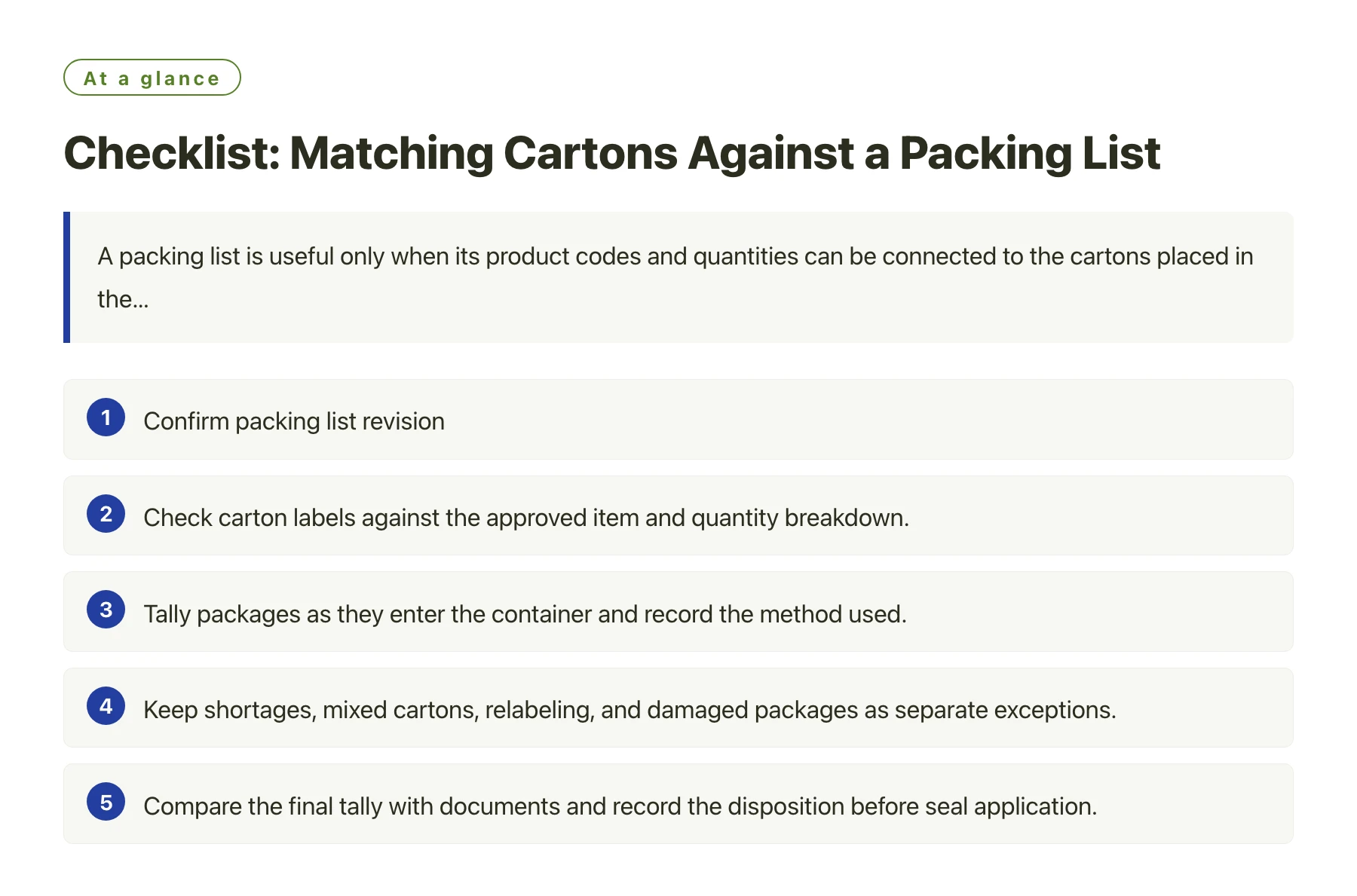
- Confirm packing list revision, purchase order, SKU, variant, and counting unit before loading.
- Check carton labels against the approved item and quantity breakdown.
- Tally packages as they enter the container and record the method used.
- Keep shortages, mixed cartons, relabeling, and damaged packages as separate exceptions.
- Compare the final tally with documents and record the disposition before seal application.
The reconciliation should show what was counted, how it was identified, and which differences remain unresolved.
1. Establish a controlled baseline
Collect the approved purchase order, latest packing list, carton-mark artwork, product schedule, and any loading instruction. Record their revision dates and identify the supplier contact who can explain a discrepancy. Confirm that the document describes the same order, production lot, and shipment as the container booking. If documents conflict, stop the comparison and identify which version the buyer has approved before the count begins.
Create a line-level tally with product code, description, variant, carton number range if used, quantity per carton, total cartons, pieces per carton, and line total. Include pallets or bundles as a separate packaging level. Do not convert between pieces and cartons without preserving the source units; mixed pack sizes can otherwise produce an apparently correct total from the wrong combination.
2. Verify carton marks and product identity
Compare a representative set of carton labels with the approved marks and packing list. Check model or SKU, color, size, lot or batch, destination, carton sequence, and other required fields. Decide in advance whether labels will be checked on every carton or sampled by a defined method. For sealed or opaque cartons, state that identity was matched from exterior marks and documents rather than claiming each inner unit was inspected.
If marks are missing, duplicated, illegible, or inconsistent, record the carton identifiers and photograph the condition. Separate cartons with mixed variants from those whose identity is unknown. Ask the supplier to provide a traceable correction or a written product mapping, then confirm that relabeling will not conceal a change or erase required lot information. Keep the original mark visible in the evidence when practical.
3. Use a repeatable counting method
Choose who counts, where the count is recorded, and how each package is marked as verified. One method is to tally carton sequence numbers as packages move from staging into the container. Another is to reconcile pallet labels with a pallet-level breakdown, then spot-check carton ranges. State the method in the report because a tally based on visible marks is different from a physical opening and piece count.
Avoid double counting cartons moved temporarily between staging and loading. Use one running log with a line for planned quantity, observed quantity, unit, count time, and initials. If loading is interrupted or another team takes over, note the handoff and resume from the last confirmed package. This creates a clear trail when two people count different sections of the same order.
4. Reconcile quantities and mixed packs
Compare planned and observed cartons by product line before aggregating the order total. Check that the carton pack quantity matches the approved schedule and that partial cartons, samples, spare parts, and promotional items are identified separately. A carton count can match while the piece quantity is wrong if pack sizes changed during production, so record both where the order requires both.
For mixed cartons, obtain a contents breakdown tied to the carton identifier. Mark the actual quantities of each SKU and variant and compare them with the approved packing list. If cartons are intentionally mixed, make sure exterior labels give receivers enough detail for receiving and inventory control. Do not assume that a carton marked “assorted” is acceptable unless the buyer agreed to that packing method.
5. Capture discrepancies without hiding them
Log shortages, overages, substitutions, duplicate labels, damaged packaging, and unclear counts as separate findings. For each, record the item, expected amount, observed amount, unit, evidence reference, person notified, and decision required. Keep arithmetic visible: show the original line total, the adjustment proposed, and the revised total. Do not silently change the packing list to make a count appear to reconcile.
Ask an authorized owner to decide whether a variance will be corrected, shipped separately, accepted as a documented deviation, or held. Confirm whether the decision changes invoice quantity, export documents, insurance details, or receiver instructions. A verbal explanation from a floor worker can help locate the cause, but the final disposition should come from the designated buyer or shipper contact and be preserved in writing.
6. Check pallet and container level totals
Where cartons are palletized, record pallet identifiers and the cartons assigned to each pallet. Check that the pallet count, carton total, and product breakdown agree. If pallets are rebuilt during loading, update the mapping rather than carrying forward a stale list. Photograph pallet marks before they become hidden and note any change in wrapping, label position, or package grouping.
During container loading, tally each package or verified pallet as it crosses the threshold. The IMO/ILO/UNECE CTU Code addresses packing and securing cargo transport units, so use an agreed loading plan and qualified personnel for technical stowage decisions; a reconciliation checklist should document identities and counts, not substitute for safe-loading expertise. [1]
7. Close the document and seal handoff
Before doors close, compare the final count with the packing list and the loading record. Confirm that exceptions have a signed or traceable disposition and that corrected documents identify their revision. If documents are still pending, mark the shipment record conditional and state whether release is authorized. A clean carton count does not resolve a missing certificate, weight record, or transport instruction unless the responsible party has also checked those requirements.
Record container number, seal number, final carton and pallet totals, date and local time, and the person accepting the handoff. Store clear photographs of the external container number, visible loaded cartons, door closure, and seal. Buyers arranging supervision during container loading can standardize the count sheet while keeping shipment-level records separate for each container and order.
Sources
Frequently asked questions
Should cartons be counted by piece or by package?
Record the unit required by the order and preserve the packaging hierarchy. For mixed pack sizes, reconcile carton counts and piece quantities separately so one cannot mask an error in the other.
What if carton labels do not match the packing list?
Identify affected cartons, photograph the labels, pause their inclusion in the final tally, and request an authorized product mapping or corrected document. Record the final disposition rather than silently relabeling the mismatch.
Can a pallet label replace a carton-level count?
Only when the approved method defines pallet identification and its contents are traceable. Record pallet IDs and carton breakdowns, and update the mapping if pallets are rebuilt or mixed during loading.
When is the packing list reconciliation complete?
It is complete when planned and observed quantities reconcile by product and unit, each variance has a documented disposition, and the final version matches the shipment record before handoff.